
South India’s most trusted roofing tile — why Mangalore tiles have been protecting homes for decades, how their curved design handles monsoon rainfall, and what correct installation by an experienced contractor makes all the difference.
Table of Contents
There’s a reason Mangalore tiles have been covering homes across Kerala and Karnataka for generations. Long before concrete, metal, or ceramic roofing existed as options, the curved terracotta tile — fired from natural clay and designed to interlock across a sloped roof — was solving the exact problems South India’s climate creates: relentless monsoon rain, coastal wind, and summer heat that builds inside poorly ventilated roofs.
Today, with dozens of roofing materials on the market, Mangalore tiles remain the most architecturally appropriate and climate-matched option for traditional South Indian homes. But their performance isn’t automatic. The most common cause of premature roof failure is not material quality — it is incorrect installation. This guide covers both: what makes Mangalore tiles genuinely worth choosing, and what correct installation looks like.
For a broader comparison of all tile types available in South India, see our complete guide to roof tile types in South India.
Mangalore tiles are interlocking terracotta roof tiles made from natural clay, kiln-fired at high temperatures to produce a dense, low-porosity tile. Their name comes from Mangalore (Mangaluru), the coastal Karnataka city where their large-scale manufacture first developed for the specific weather conditions of the Karnataka and Kerala coasts.
The defining feature is the tile’s curved, S-shaped interlocking profile. Each tile overlaps and locks with the one below and beside it, creating a continuous, self-draining surface across the roof slope. This isn’t decorative geometry — it’s structural engineering in fired clay. The curve channels rainwater downward course by course, preventing pooling at any joint. The interlocking edges resist wind uplift in ways that flat-overlap tiles cannot.
Made from natural clay and free from harmful chemicals, Mangalore tiles are a genuinely eco-friendly building material — biodegradable, sustainable, and safe for the environment.
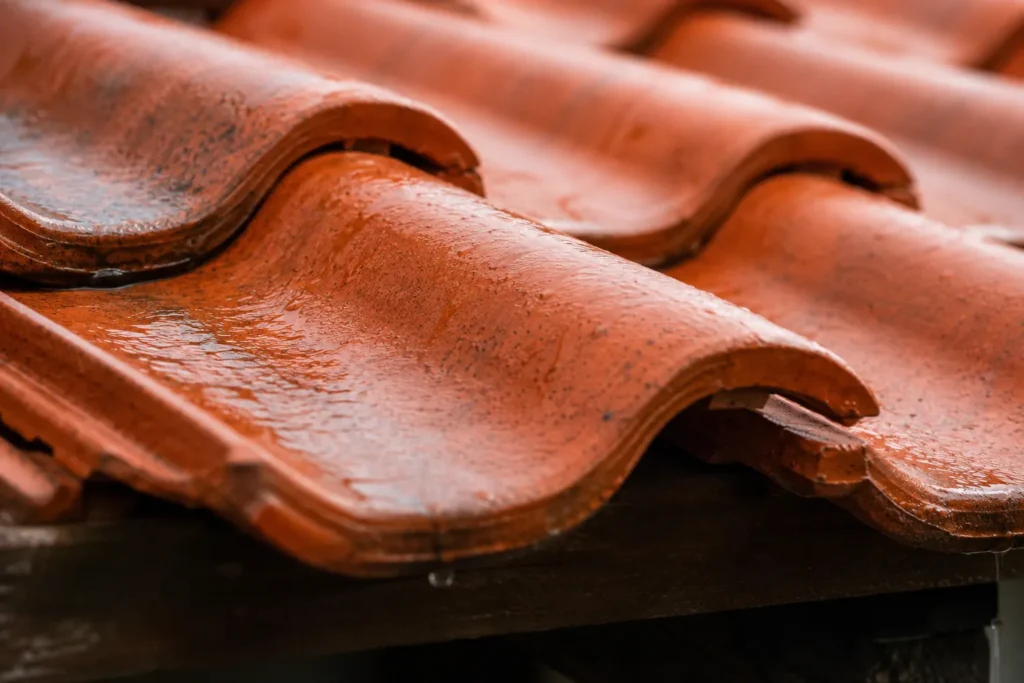
South India’s monsoon is not gentle. Kerala and coastal Karnataka receive between 2,500mm and 4,000mm of rainfall annually. During the peak Southwest Monsoon months of June through September, rainfall arrives as sustained heavy downpours — often wind-driven — for days at a time. The roof above your home bears all of it.
Mangalore tiles address this in two specific, structural ways:
The curved design of Mangalore tiles ensures rainwater flows off the roof smoothly and continuously. Water follows the curve of each tile downward, course by course, without pooling at any overlap joint. This is the single most important waterproofing mechanism in the tile’s design — and it functions without any sealant, coating, or treatment.
The interlocking profile means each tile is held in place by the geometry of the tiles around it — not just by mortar or gravity. Mangalore tiles stay in place even during strong winds, making them ideal for monsoon-heavy coastal areas where wind-driven rain puts sustained lateral pressure on the roof surface.
To perform correctly, Mangalore tiles require a minimum roof pitch of 30°. At this slope, the curved profile and gravity work together to keep water moving. On insufficiently sloped roofs, even the best Mangalore tile will pond at joints and leak. Confirming slope before tile selection is non-negotiable.
🌿 Why this matters for Kerala & Karnataka specifically
Both states experience the Southwest Monsoon at full intensity — sustained rainfall, coastal wind exposure, and high year-round humidity. Mangalore tiles were developed specifically for these conditions. No other roofing material has the same design pedigree for this exact climate.
Mangalore tiles made from high-quality clay and kiln-fired at high temperatures have a lifespan of over 50 years with minimal maintenance. This is one of the longest lifespans of any roofing material available in South India — comparable to ceramic tiles and quality metal roofing installations.
| What Extends Lifespan | What Shortens It |
|---|---|
| High-quality, high-fired clay tiles from a reputable kiln | Low-fired tiles with higher porosity — absorb moisture and crack faster |
| Correct installation on a 30°+ roof pitch | Installation on insufficient slope — creates ponding at joints |
| Annual pre-monsoon ridge mortar inspection and repointing | Neglected ridge mortar — the #1 entry point for roof leaks |
| Periodic moss and algae treatment on shaded sections | Untreated biological growth — accelerates surface deterioration |
| Correctly designed roof structure handling the tile load | Undersized rafters or purlins — leads to structural deflection over time |
The single biggest lifespan factor: Installation quality. A correctly installed Mangalore tile roof will consistently outperform an expensive tile installed by an inexperienced contractor. This is why Royal Roofs places as much emphasis on supervised on-site execution as on material selection.
✓ Strengths
✗ Limitations
✓ Well Suited For
✗ Not the Right Fit For
💡 Not sure if Mangalore tiles suit your roof?
The right tile depends on your roof pitch, structure, location, and the architectural style of your home. Royal Roofs offers a free site inspection — our team assesses your specific conditions and gives you a written recommendation before any commitment.
Royal Roofs has been installing roofing systems for residential and commercial projects since 1985. Over four decades, we have executed installations across Karnataka, Kerala, Tamil Nadu, Goa, and Mumbai. The single most consistent finding across those projects is this:
The most common cause of premature roof failure is not material quality — it is incorrect installation. Misaligned tiles allow water ingress. Inadequate fixing creates wind vulnerability. Poor joint sealing enables moisture infiltration that deteriorates the structure over years. A properly installed Mangalore tile roof of moderate specification consistently outperforms an expensive tile installed by an inexperienced contractor.
Structural evaluation of the existing framework before any work begins — identifying load points, drainage requirements, roof pitch, and material suitability for the specific site and climate.
Selection of roofing type, material specification, and installation method based on the project scope — residential, commercial, or institutional. We do not apply a one-size-fits-all method.
Materials are cut, shaped, and prepared to specification before reaching the site — reducing on-site error and installation time.
Every tile is installed with alignment checks, fixing standards, and weather sealing applied at each stage under site supervision.
A post-installation walkthrough covering structural alignment, waterproofing joints, drainage flow, and finishing quality before handover.
Royal Roofs executes roof installation projects across Karnataka, Kerala, Tamil Nadu, Goa, and Mumbai. For existing structures, we assess the framework condition first — if reinforcement is needed, we address that before the roofing system goes in. Learn more about our roof installation service →
A Mangalore tile roof is one of the lowest-maintenance roofing options in South India — but “low maintenance” is not “zero maintenance.” The difference between a roof that lasts 30 years and one that lasts 50+ years is almost always a consistent pre-monsoon inspection routine.
Through scheduled inspections and targeted maintenance services, Royal Roofs helps preserve your roof’s structural integrity and performance — identifying early warning signs before they become costly problems. Our maintenance service covers:
For a complete seasonal maintenance guide, see our article on the importance of regular roof maintenance. If you’re already seeing signs of a problem, our guide on how to repair a leaking roof explains when a repair is sufficient and when replacement is the right call.
Key Takeaways
How long do Mangalore tiles last?
Mangalore tiles made from high-quality clay and kiln-fired at high temperatures have a lifespan of over 50 years with minimal maintenance. The key factors are tile firing quality, correct installation on a suitably sloped roof, and annual pre-monsoon ridge mortar inspection.
Why are Mangalore tiles suitable for monsoon regions?
The curved design of Mangalore tiles ensures rainwater flows off the roof smoothly without pooling at any joint. The interlocking profile means each tile is held in place by the geometry of the tiles around it, keeping them stable even during strong monsoon winds. This design combination makes them specifically suited to the high-rainfall coastal conditions of Kerala and Karnataka.
What pitch (slope) does a Mangalore tile roof need?
Mangalore tiles perform best on roof pitches of 30° or steeper. On insufficient slopes, even high-quality tiles will pond water at the overlap joints and eventually leak. Confirming your roof pitch with a professional before specifying tile type is essential — below 20°, metal roofing is the correct choice.
Do Mangalore tiles need waterproofing treatment?
High-quality, high-fired Mangalore tiles do not require surface waterproofing treatment — the dense fired clay surface is inherently water-resistant. The vulnerable points are mortar joints at the ridge line and hip junctions, which require inspection and repointing every 10–15 years. No paint, coating, or sealant is needed on the tile surface itself.
Are Mangalore tiles suitable for coastal homes in Kerala?
Yes — Mangalore tiles are among the most coastal-suitable roofing materials available. Unlike metal roofing, which corrodes in salt-laden coastal air without Galvalume or aluminium specification, fired clay Mangalore tiles have zero corrosion risk and no surface coating to degrade. They were developed for coastal Karnataka and Kerala conditions.
What are Mangalore tiles made of?
Mangalore tiles are made from natural clay, kiln-fired at high temperatures to produce a dense, low-porosity tile. They contain no harmful chemicals and are biodegradable — making them an eco-friendly roofing material. The high firing temperature is what determines density, water resistance, and lifespan.
How does Royal Roofs approach Mangalore tile installation?
Royal Roofs has been installing roofing systems since 1985 across Karnataka, Kerala, Tamil Nadu, Goa, and Mumbai. Our installation process covers site assessment, system design, precise material preparation, controlled on-site execution, and a final inspection before handover. We place as much emphasis on supervised execution as on material selection — because correct installation is what determines whether a Mangalore tile roof reaches its full 50+ year lifespan. See our roof installation service →
How do I maintain a Mangalore tile roof?
Annual pre-monsoon maintenance is the most important routine for a Mangalore tile roof. This covers clearing gutters and valleys, inspecting and repointing cracked ridge mortar, treating any moss or algae on shaded sections, and checking hip and flashing junctions. Individual cracked or broken tiles should be replaced promptly. Royal Roofs provides scheduled maintenance and cleaning services — get in touch to schedule an inspection.
Can I replace individual Mangalore tiles without redoing the whole roof?
Yes — this is one of Mangalore tiles’ significant practical advantages. Individual cracked or broken tiles can be lifted and replaced without disturbing the rest of the roof. The main consideration is colour matching: tiles from different batches or kiln firings can vary slightly in shade. For older roofs, matching the existing tile colour may require sourcing from the same manufacturer or accepting a slight variation.
Installing Mangalore Tiles on Your Home?
Royal Roofs has been installing roofing systems across Kerala, Karnataka, Tamil Nadu, Goa, and Mumbai since 1985. Every project starts with a free site inspection — no obligation, just expert assessment you can build on.