
| What | A climate-based comparison of all major roof tile types used in South India |
| Who | Homeowners in Kerala, Karnataka, Tamil Nadu & Andhra Pradesh planning new builds or roof replacements |
| Why | South India’s tropical climate demands roofing that handles monsoon rain, coastal humidity & summer heat simultaneously |
| When | Relevant before construction, renovation, or replacing an ageing roof — especially pre-monsoon |
| How | Side-by-side tile comparison, climate suitability ratings, cost data & a homeowner buying checklist |
Most homeowners spend months choosing floor tiles. They spend less than a week choosing roof tiles.
That’s a costly mistake. Your roof faces 120+ days of rainfall, 40°C summer heat, and coastal humidity that no other surface in your home experiences. Choose the wrong tile type — based on looks or the contractor’s convenience — and you’re looking at leaks within three monsoon seasons, cracked surfaces by year five, and a full replacement well before the 15-year mark.
The right roof tile, correctly installed, can protect your home for 40–60 years. The wrong one starts failing quietly from day one.
This guide breaks down every major roof tile type used in South India — Mangalore tiles, clay tiles, concrete roof tiles, ceramic roofing tiles, and metal roofing — with honest assessments of how each performs in the specific conditions of Kerala, Karnataka, Tamil Nadu, and Andhra Pradesh. You’ll get real cost data, climate suitability ratings, maintenance requirements, and a buying checklist you can use before signing any contractor agreement.
For a broader overview of roofing systems before diving in, our Ultimate Guide to Roofing covers the full picture every homeowner should know.
Table of Contents
Here’s what most generic roofing guides miss: South India isn’t one climate. It’s four distinct micro-climates that each punish unsuitable roofing materials in their own way.
Kerala & Coastal Karnataka receive 2,500–4,000mm of annual rainfall — among the highest in Asia. The Southwest Monsoon arrives in force every June, bringing sustained horizontal rain at wind speeds of 60–100 km/h in coastal districts. A roof here needs aggressive water-shedding geometry and materials that resist biological growth (moss, algae, lichen) between dry and wet cycles.
Tamil Nadu’s Eastern Coast gets its heaviest rainfall during the Northeast Monsoon (October–December), creating a second annual stress cycle that most mainland roofing guides ignore entirely. Cyclonic wind events add structural load demands on top of waterproofing requirements.
Interior Deccan & Andhra Plains face the opposite problem: punishing summer heat reaching 42–45°C, followed by sudden monsoon rainfall. Thermal cycling — the expansion and contraction of roofing materials across a 30°C daily temperature swing — is the primary failure mechanism here, causing cracking, joint failure, and accelerated tile deterioration.
Coastal Zones Across All Four States add salt-laden air that corrodes standard metal roofing 3–5x faster than inland locations, making material specification — not just type — critical for homes within 10km of the coastline.
The practical implication: A tile that performs excellently in Coimbatore may fail within five years on the Malabar coast. Climate-matched roofing isn’t a premium choice — it’s the minimum standard.
For homeowners in Kerala specifically, our dedicated guide on Best Roofing Material for Kerala Climate covers state-specific conditions in greater depth.
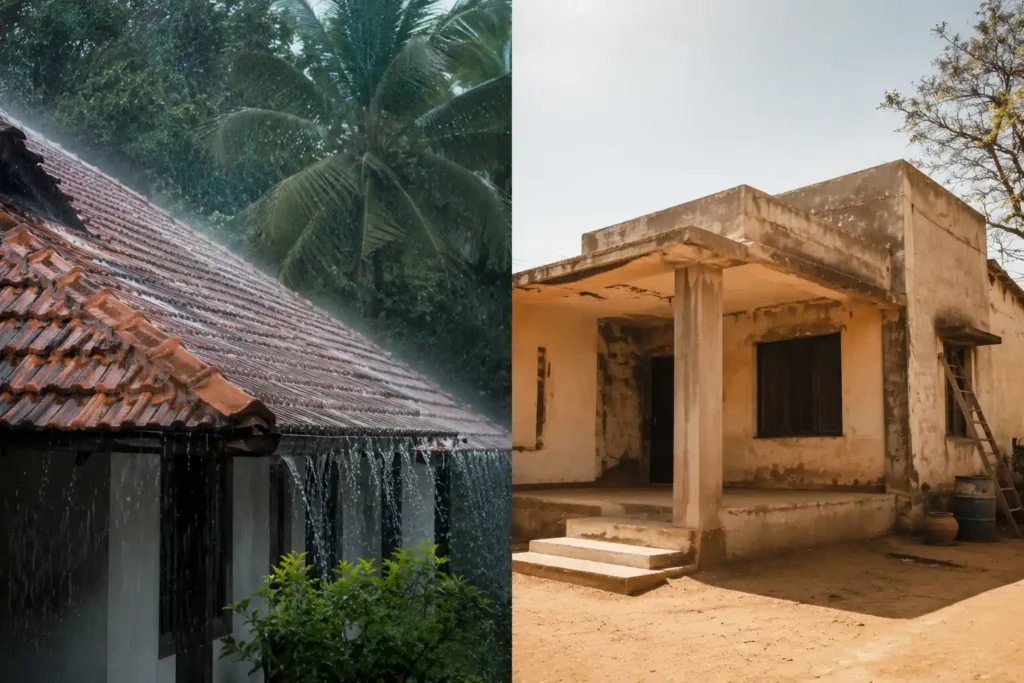
The most iconic roofing material in South India. Mangalore tiles — also called Mangalorean tiles or calicut tiles — are interlocking terracotta tiles fired at high temperatures, originally developed for the specific weather conditions of the Karnataka and Kerala coasts.
These aren’t the porous, crumbling tiles of old construction. Modern high-fired Mangalore tiles from manufacturers like Paavalampatti, Mangalam Cement, or traditional kilns in Udupi district are dense, low-porosity, and dimensionally consistent. The classic S-curved interlocking profile channels rainwater into continuous drainage paths, making them extremely effective on roofs pitched at 30° or steeper.
What makes them genuinely suited to South India:
Where they fall short:
Best for: Traditional South Indian homes, coastal bungalows, heritage-style constructions, and any sloped roof with 30°+ pitch in Kerala, Karnataka, and Goa.
Clay roof tiles in South India encompass several regional variants beyond the Mangalore interlocking profile. Country tiles (flat clay tiles with simple overlap), Athangudi-style decorative tiles, and pan tiles all fall under this category. Like Mangalore tiles, they’re fired terracotta — but differ in profile, thickness, and the roof pitch they’re designed for.
Flat clay tiles work well on pitches between 22° and 45°, tolerate moderate rainfall well, and offer excellent thermal performance. Their simpler profile makes installation faster and replacement easier than Mangalore tiles, since individual pieces don’t rely on interlocking geometry.
What makes them work in South India:
Where they fall short:
Best for: Homes in interior Karnataka, Tamil Nadu hill areas, and any region where Mangalore tile’s interlocking system isn’t architecturally required but clay’s thermal performance is valued.
Concrete tiles — cement-based, machine-pressed — have gained significant market share across South India over the past 15 years. They’re heavier than clay at 45–60 kg/sq.m, offer good structural strength, and come in a wider variety of profiles and colours than traditional clay options.
Brands like Eternit, Boral, and local South Indian manufacturers produce concrete tiles across several profiles: flat, interlocking, barrel-curved, and Roman. A properly manufactured and installed concrete tile performs reliably in moderate rainfall zones.
What makes them appealing for South Indian homeowners:
Where they fall short:
Best for: Urban residential construction in Bengaluru, Chennai, Hyderabad, and interior South Indian cities where moisture intensity is moderate and architectural variety is preferred.
Ceramic tiles bridge the gap between traditional clay and modern engineered materials. Manufactured from refined clay fired at higher temperatures than standard country tiles, ceramic roofing tiles are denser, less porous, and more dimensionally precise than their terracotta counterparts.
High-quality ceramic roof tiles from manufacturers like RAK Ceramics or specialty South Indian kiln operators offer compelling performance in South India’s climate — particularly their resistance to biological growth and their maintained waterproofing without surface treatment.
What makes them stand out:
Where they fall short:
Best for: High-value residential projects where low maintenance and long-term appearance are priorities — premium homes in Kochi, Bengaluru, Chennai’s upmarket suburbs, and coastal villas where the tile’s natural resistance to biological growth justifies the higher upfront investment.
Metal roofing isn’t technically a “tile” in the traditional sense — but it’s the fastest-growing roofing category in South India’s residential market and belongs in any honest comparison. Colour-coated steel, Galvalume (steel-aluminium-zinc alloy), and aluminium standing-seam panels are now being used on contemporary sloped roofs, replacing tiles in both new construction and renovation projects.
Modern metal roofing has addressed its historic weaknesses — heat transfer, noise, and corrosion — through PVDF-coated surfaces, glass wool insulation layers, and Galvalume alloy formulations that significantly outperform standard GI sheets in humidity and coastal salt environments.
What makes it highly competitive in South India:
Where it needs specification care:
Best for: Modern contemporary homes, commercial buildings, home extensions, buildings in areas where low slope geometry is preferred, and any project where minimal long-term maintenance is a top priority. Also the best option for re-roofing flat RCC roofs that have persistent leak problems.
For a detailed head-to-head between these two most popular options, read our Metal Roofing vs. Tile Roofing comparison guide.
See the full comparison table below — structured for quick decision-making across South India’s key selection criteria.
| Tile Type | Monsoon Performance | Heat Comfort | Lifespan | Cost ₹/sq.ft (Installed, 2026) | Maintenance | Coastal Suitability | Best Architecture |
|---|---|---|---|---|---|---|---|
| Mangalore Tiles | ⭐⭐⭐⭐⭐ | ⭐⭐⭐⭐⭐ | 40–60 yrs | ₹110–₹200 | Medium | Excellent | Traditional, Heritage |
| Clay Tiles (Country) | ⭐⭐⭐⭐ | ⭐⭐⭐⭐⭐ | 35–50 yrs | ₹90–₹160 | Medium | Good | Traditional, Rural |
| Concrete Tiles | ⭐⭐⭐ | ⭐⭐⭐ | 25–40 yrs | ₹80–₹140 | High | Moderate | Urban Contemporary |
| Ceramic Tiles | ⭐⭐⭐⭐⭐ | ⭐⭐⭐⭐ | 40–60 yrs | ₹140–₹240 | Low | Excellent | Premium Residential |
| Metal Roofing | ⭐⭐⭐⭐⭐ | ⭐⭐⭐ (w/ insulation) | 40–60 yrs | ₹90–₹170 | Very Low | Good–Excellent* | Modern Contemporary |
Galvalume/aluminium grade essential for coastal zones within 10km of the sea. Costs are installed rates (material + structure + labour) as of May 2026. Prices in Kochi and Chennai typically run 8–12% higher than interior districts.
There’s no single correct answer — but there is always a right answer for your specific situation. Here’s how to match tile type to context:
If you’re building a traditional Kerala or Karnataka-style home: Mangalore tiles are the definitive choice. Nothing else delivers the same combination of thermal comfort, rain-shedding performance, and architectural authenticity. Pair them with an RCC ring beam structure rather than timber rafters for a longer-lasting, lower-maintenance base.
If you want clay’s thermal performance at a lower entry cost: Country clay tiles on a 25°+ sloped roof deliver excellent comfort in interior regions. They work particularly well in Tamil Nadu’s hill districts and interior Karnataka where rainfall intensity is moderate.
If your home has a contemporary flat-facade design with a low slope: Metal roofing is your most practical option. No tile type performs well on low pitches — and metal standing-seam systems are engineered precisely for that geometry.
If you want minimal lifetime maintenance and maximum longevity: Ceramic tiles offer the lowest ongoing maintenance among all tile options. The dense fired surface resists biological growth without periodic chemical treatment, making it the smart choice for homeowners who don’t want annual roof maintenance obligations.
If you’re re-roofing a flat RCC terrace that keeps leaking: Consider a metal roof overlay rather than another waterproofing treatment. If your flat roof has had two failed waterproofing attempts, the structural slope or slab cracks are the root problem — and a metal roof over a new structure solves it permanently. Our guide on Roof Waterproofing vs. Roof Replacement will help you make that call.
Every tile type has a minimum slope requirement. Concrete and clay tiles need at least 22–25°. Mangalore interlocking tiles perform best at 30°+. Installing tiles on an insufficient slope creates chronic ponding at the overlap joints — the single most common cause of tile roof leaks in South India.
The fix: Confirm your structural slope with a professional before specifying tile type. If your planned slope is below 20°, metal roofing is the correct answer — not a cheaper tile.
Uncoated concrete tiles absorb moisture. In Kerala’s coastal humidity (75–90% relative humidity year-round), this moisture absorption cycle accelerates surface degradation, enabling algae growth and cracking within 5–8 years.
The fix: Specify coated concrete tiles only, and budget for re-coating every 8–10 years. Or choose Mangalore tiles or ceramic tiles for coastal locations — neither requires surface treatment to maintain waterproofing.
The ridge line — where two sloping planes meet at the top — is the most vulnerable point on any tile roof. Ridge mortar cracks are the entry point for 60–70% of tile roof leaks in South India. Most homeowners never inspect this until a leak appears inside.
The fix: Include ridge inspection and repointing in your annual pre-monsoon maintenance routine. This is a 2–3 hour job for a professional and costs far less than a water-damaged ceiling.
Plain galvanised iron sheets corrode visibly within 5–8 years in coastal South India’s salt-air environment. Many budget installations use standard GI because it’s cheaper by ₹20–₹30 per sq.ft — but the corrosion timeline makes the total cost of ownership significantly higher.
The fix: Within 10km of any coastline across Kerala, Karnataka, Tamil Nadu, or Andhra Pradesh — specify Galvalume or aluminium only. The price premium is 15–25%. The lifespan difference is 30+ years.
Switching from metal sheets to heavy clay tiles on an existing roof structure without a load assessment is a structural risk. Clay tiles at 45–55 kg/sq.m vs. metal at 8–12 kg/sq.m represent a 4–5x increase in dead load on rafters designed for the lighter material.
The fix: Always engage a structural engineer for a load assessment before changing tile types on an existing structure — especially on older timber-framed roofs common in Kerala’s heritage homes.
Manufacturers offer concrete and metal tiles in dozens of colours. Several homeowners choose roofing materials based on colour matching their exterior paint — then discover the chosen tile type is incompatible with their roof pitch, climate zone, or maintenance budget.
The fix: Select your tile type first based on climate, pitch, and lifespan requirements. Then choose the best available colour within that type. If your first-choice material doesn’t come in your preferred colour — that’s an acceptable trade-off for 40 years of performance.
For a full rundown of warning signs that your current roof needs attention, read our article on 5 Signs You Need a Roof Replacement.
Use this before your contractor conversation. It prevents the most expensive decisions from being made by default.
Structural Checks
Climate & Location Checks
Material Specification Checks
Contractor Checks
For a comprehensive guide to evaluating roofing contractors, our How to Choose the Right Roofing Contractor guide covers every question worth asking before you sign.
South India’s roofing market has never had more options — and the gap between a well-chosen tile and a poorly chosen one has never been wider. The homeowners who get this decision right don’t just save money on repairs. They live in cooler, quieter homes that protect their families through decade after decade of monsoon seasons without a single leak.
Four things to take away from this guide:
Your roof is the most structurally important surface your home has. Give it the same attention you’d give your foundation — and it will last just as long.
Not sure which tile type is right for your specific home? Book a Free Site Inspection with Royal Roofs — our team assesses your structure, location, and climate zone and gives you a written recommendation you can trust, with no obligation.
Mangalore tiles remain the most widely used tile type across Kerala, coastal Karnataka, and Goa due to their proven performance in high-rainfall tropical conditions. In urban areas of Tamil Nadu and Andhra Pradesh, concrete tiles have gained market share. Metal roofing is the fastest-growing category across all four states, particularly in new residential construction after 2020.
High-quality, high-fired Mangalore tiles installed on a properly designed sloped roof typically last 40–60 years in South India’s climate. The primary maintenance requirement is ridge mortar repointing every 10–15 years and periodic moss/algae treatment. Individual tile replacement is straightforward and does not require disturbing the whole roof.
Concrete tiles perform adequately in moderate-rainfall interior regions of South India, but have significant limitations in Kerala’s high-humidity, high-rainfall coastal climate. Without regular surface coating maintenance, concrete tiles absorb moisture, degrade faster, and require recoating every 8–10 years. Clay or Mangalore tiles are generally the better long-term choice for Kerala homes.
Mangalore tiles are a specific type of clay roof tile — interlocking, S-curved in profile, and fired to a high temperature. The term “clay tiles” covers a broader category including flat country tiles, pan tiles, and other regional variants. Mangalore tiles are specifically engineered for high-rainfall performance through their interlocking design, while other clay tile types may use simpler overlap installation methods better suited to moderate rainfall zones.
For the hot dry interior regions of Tamil Nadu, Andhra Pradesh, and Telangana, clay and Mangalore tiles offer the best natural thermal comfort without additional insulation. The thermal mass of fired clay absorbs heat slowly during the day and releases it at night, keeping interior temperatures noticeably lower than metal or concrete alternatives. For sloped roofs in these regions, high-quality clay tiles are the recommended first choice.
As of May 2026, fully installed costs range from ₹80–₹140/sq.ft for concrete tiles, ₹90–₹200/sq.ft for clay and Mangalore tiles, ₹140–₹240/sq.ft for ceramic tiles, and ₹90–₹170/sq.ft for metal roofing. These are installed rates covering material, structure preparation, and labour. Prices in major cities like Kochi, Chennai, and Bengaluru run approximately 8–12% higher than interior district rates. Always request itemised written quotes from at least three contractors before committing.
High-quality fired clay and Mangalore tiles do not require regular surface waterproofing treatment — the dense fired clay is inherently waterproof at the tile surface. The waterproofing risk points are mortar joints at the ridge, hips, and flashings, which require inspection and repointing every 10–15 years. Concrete tiles, however, require periodic surface coating renewal to maintain their waterproofing. For flat RCC roofs, a separate waterproofing system is essential regardless of whether tiles are used. Learn more about when to waterproof vs. replace your roof.
Annual pre-monsoon maintenance is the most important investment for any tile roof in South India. This covers clearing gutters and roof drains, inspecting and repointing cracked ridge mortar, treating moss or algae with an approved biocide spray, and checking flashings around chimneys and vents. Post-monsoon inspection in October–November catches any tiles displaced or cracked during heavy rains. A professional inspection every 12–18 months is the minimum recommended frequency. Our article on the importance of regular roof maintenance has a complete seasonal maintenance plan.
For questions about your specific roof, contact Royal Roofs for a free site assessment. We serve homeowners across Kerala, Karnataka, and Tamil Nadu.